
Most small goods businesses optimise everything except the step that happens right before the product ships.
Product labelling efficiency in Australia is where small product businesses quietly lose time, money, and consistency. It is rarely the first thing a brand optimises, and it is almost always one of the last. By the time labelling becomes a visible problem, it has usually been a hidden one for a while. The production process slows, orders back up, and the culprit turns out to be a step that most brands never thought to examine.
The step nobody optimises
Small businesses spend considerable energy getting the product right. The formulation, the recipe, the manufacturing process, the packaging design these get attention, iteration, and investment because they are visible and because they directly affect what the customer receives.
Labelling sits at the end of that process, so it often gets whatever attention is left. Businesses choose a sticker format quickly, apply labels by hand, and assume the process will scale with the rest of the operation. It rarely does.

The reason is that labelling is labour-intensive in a way that most other production steps are not. Mixing a larger batch of product does not take more time per unit proportionally. Manufacturing at higher volumes typically gets more efficient as it scales. Applying stickers one at a time, by hand, from a sheet, scales in exactly the opposite direction. Every additional unit requires the same handling time as the first. There is no efficiency gain. There is only more of the same work.
The process works at twenty units a week. It starts to creak at two hundred. By the time you’re producing two thousand, labelling has become the bottleneck that sets the pace for everything else. Product labelling efficiency in Australia is a problem that tends to announce itself only once it has already cost the business more than it should have.”
Where product labelling efficiency in Australia breaks down
The labelling bottleneck in Australian small businesses tends to show up in four specific ways, and most brands experience more than one of them before they address the underlying problem.
Inconsistent placement is the first. Hand-applying stickers from a sheet without a jig or a guide produces placement variation across a batch. On a small run, the inconsistency is barely noticeable. On a larger run destined for retail or a wholesale account, it looks like a quality control problem. Buyers and retailers notice label placement. Consumers notice it too, even if they cannot articulate exactly what looks off about a product that is otherwise well made.
Throughput is where the cost becomes obvious. A business can produce and fill a hundred units in an afternoon, then spend just as long applying the labels. Once labelling limits how many products leave the premises each day, it starts limiting revenue. That constraint is invisible until volume reaches the point where it becomes impossible to ignore.

Then there is format. Sheet stickers are the default starting point for most small brands, and they are the right format at low volumes. The problem is that most businesses never revisit the decision as they grow. Labelling rarely makes it onto the quarterly review agenda, so the original choice sticks around far longer than it should.
Hidden labour cost is the fourth, and it’s the one most businesses underestimate. Manual labelling rarely appears on a production cost sheet alongside ingredients, packaging, or postage. Instead, it gets folded into the general effort of running the business. A few minutes here. Another batch there. It doesn’t feel expensive because nobody is measuring it. Once that time is properly costed, though, the numbers are often higher than expected. Suddenly, investing in a faster sticker format or a more efficient workflow stops looking like an expense and starts looking like an easy business decision.
The format decision that drives most of the problem
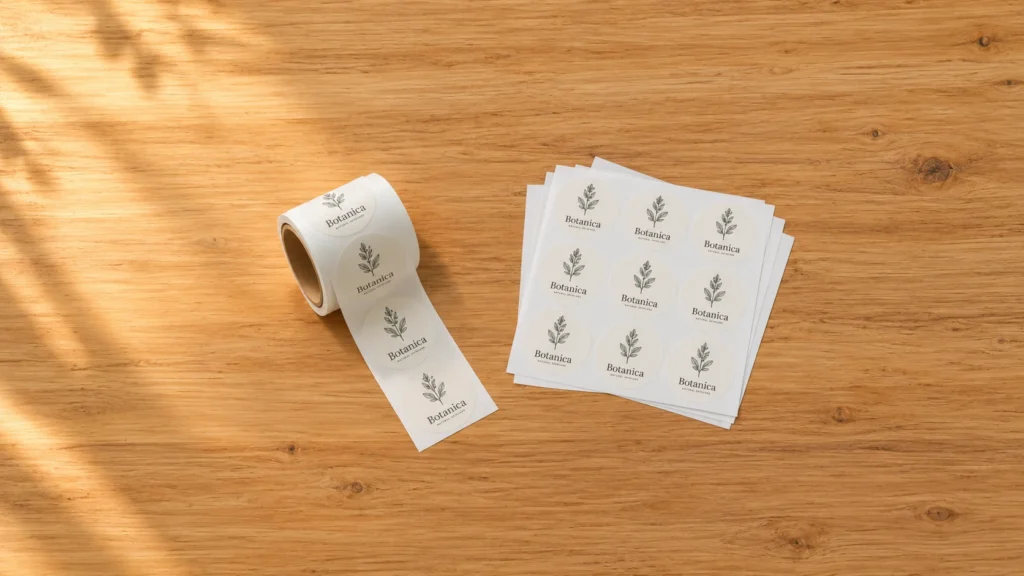
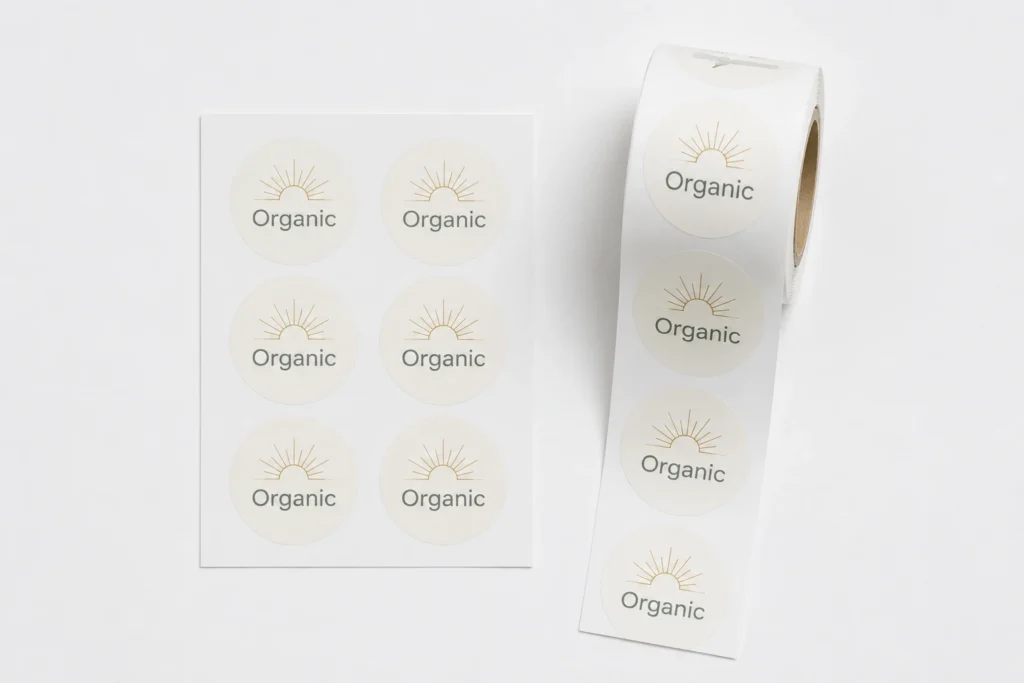
Most labelling inefficiency in small goods businesses traces back to a single decision made. Sheet stickers are the natural starting point. They are flexible, the minimums are low, and they suit the manual, small-batch production that most brands begin with. For a business producing fewer than a hundred units at a time, sheets are genuinely the right format. The problem is that businesses often make the decision once and never revisit it, even after they’ve outgrown the conditions that made it the right choice.
Roll stickers change the labelling dynamic in one significant way: they make consistent, continuous application possible. A roll sitting on a dispenser removes the handling step of picking up individual sheets and finding the next sticker on the backing. A roll feeding through a label applicator removes the manual application step entirely. Neither of these is a radical change in isolation. Together, they can reduce labelling time per unit by more than half at meaningful volumes.
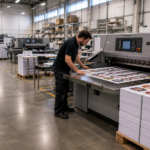
Many small Australian businesses assume label applicators are expensive or only make sense for large manufacturers. In reality, entry-level applicators often pay for themselves surprisingly quickly once the labour savings are properly costed.
How Australian businesses improve product labelling efficiency
The fix is seldom complicated. It is usually a format change, a process change, or both, applied at the right moment in the business’s growth.
Start with volume. If you are applying more than a few hundred labels a week by hand from sheets, roll format is worth trialling. The transition does not require an applicator to deliver a meaningful efficiency gain. A roll on a simple dispenser is faster and more consistent than sheets at almost any meaningful volume.
Then labour. Take the time spent on labelling in a typical production run and attach an hourly rate to it. For most small goods businesses, the result is a number that makes a format change or a process investment look straightforward rather than expensive.

Then applicators. The threshold is different for every business, but a useful starting point is this: if labelling is taking more than a few hours per week and the volume is consistent rather than occasional, the case for an applicator is worth making. Most basic applicators pay for themselves within a production cycle or two at that volume.
Finally, future ordering. Build the format decision into the ordering process. Once you’ve confirmed the design and know the expected volume, choose the format that fits from the outset instead of switching midway through production.
When the bottleneck is actually a sign of growth
Product labelling efficiency in Australia is rarely framed as a growth indicator, but it is exactly that. If labelling is slowing your business down, that is not just a production problem. It is evidence that volume has grown beyond the process that was built for an earlier stage of the business. That is a good problem to have.
The brands that get stuck in the labelling bottleneck are usually the ones that treat it as a source of frustration rather than a signal. The ones that move through it quickly are the ones that recognise the bottleneck for what it is, a process that has not kept up with growth, and address the format and workflow decision that sits underneath it.
For most AU small product businesses, that decision is simpler than it appears. Roll format, a basic dispenser, and in some cases a label applicator, resolves the bottleneck at a cost that is almost always lower than the ongoing labour it replaces.

Final Thoughts
Labelling is the last step before a product ships and the step most brands are slowest to optimise. It does not change the product itself. It changes how efficiently you can get that product into a customer’s hands.
For Australian product businesses choosing between sheet and roll formats, OzStickerPrinting offers both across vinyl, paper, and kraft materials, with low minimums that make it easy to trial roll stickers before committing to larger volumes. For a closer comparison, the Roll Stickers vs Sheet Stickers guide explores the differences in detail. You can also browse the full range of custom stickers and labels for Australian businesses.